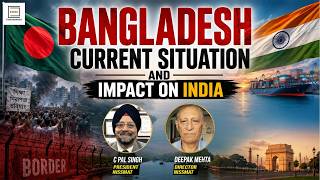
“Join Pawanjit Ahluwalia, Maj Gen Deepak Mehta (Retd) and Dr. Sanchita Bhattacharya at the NISSMAT think tank as they deconstruct the India-Bangladesh ‘Strategic Reset.’ Is PM Tarique Rahman a partner or a challenge? Watch now!”
What this session covered
This session, recorded in April 2026 and moderated by NISSMAT, brought together two guests to examine India's relationship with Bangladesh in the first weeks of the new BNP government that took office after the February elections. The moderator framed the question as whether the change in Dhaka represents a genuine strategic reset or a pragmatic survival strategy, with both capitals still testing each other's limits. One speaker suggested it was a mixture of the two, pointing to inflation, currency pressure and an export base concentrated in garments as constraints on the new administration, alongside its need to consolidate domestic authority. Early contacts were noted, including a visit to Delhi by a senior Bangladeshi minister and a meeting in Dhaka involving India's high commissioner, together with Indian supplies of 50,000 tons of diesel, electricity exports and an approval for 200 railway coaches.
A substantial part of the discussion concerned Bangladesh's internal balance. The other speaker emphasised the changed position of the main Islamist party, which she said had secured 68 seats in its own right and now sits in opposition rather than in alliance with the BNP as in earlier tenures, and argued that this gives it bargaining leverage over the government. She cautioned that it was too early to judge the new administration, having been in office less than sixty days, and set out a view that the risk of activity by jihadi and previously unrestrained elements would require vigilance over the coming months. Other points raised included the new prime minister's stated commitments on religious minorities and indigenous people, a reported reduction in the scale of reported violence compared with the preceding period, the restoration of music and fine arts in school curricula, and an overhaul of administrative appointments. One speaker explicitly disputed the characterisation of the 2024 uprising as a youth or "Gen Z" movement, arguing instead that it was organised, while also acknowledging genuine resentment among young people over corruption and lack of opportunity. It was noted that a party formed out of those protests won six seats.
On bilateral questions, the discussion covered Bangladesh's likely requests to India: greater market access to reduce the trade deficit, improved connectivity, and increased supplies of diesel and fertiliser, with the observation that nothing had yet been settled on paper. Bangladesh's forthcoming graduation from least developed country status in November and its energy difficulties were raised, as was a Bangladeshi committee's recommendation to cancel or renegotiate an electricity supply arrangement with an Indian private supplier, and a separate suggestion there that transshipment charges paid by India should be revised. On security, the speakers discussed the 4,000 km land border, recurring incidents and killings along it, the enclave question, and the risk that insurgent groups from the North East might again find shelter across the border; military-to-military exchanges, including officer courses, were described as continuing normally. Illegal migration and demographic change in West Bengal, Assam, Meghalaya and Jharkhand were treated at length, with one speaker arguing that political incentives around voter registration complicate enforcement. The Siliguri corridor was addressed in terms of migration, insurgency and reported Chinese assistance to an airfield, though one speaker held that Indian forces in the area are adequate. On water, the discussion covered the Ganges treaty renewal due this year, the unresolved Teesta question, which both described as primarily political, and Chinese damming on the Brahmaputra; one speaker considered water more likely to prove a breaking point than a bonding point.
Key points raised
- The new government in Dhaka was described as pursuing a Bangladesh-first, transactional approach, driven by a combination of strategic calculation and domestic survival needs rather than personal chemistry with Delhi.
- One speaker argued that the main Islamist party's move from alliance partner to opposition, holding 68 seats in its own right, gives it leverage over the government and constitutes the most significant change from earlier BNP tenures.
- Early bilateral contacts were noted, including ministerial visits and Indian supplies of 50,000 tons of diesel, electricity and an approval for 200 railway coaches, but the discussion stressed that nothing substantive had yet been concluded on paper.
- Bangladesh's requests were characterised as greater market access, improved connectivity and increased diesel and fertiliser supplies, set against slowing growth, high inflation, an energy shortfall and graduation from least developed country status due in November.
- Illegal migration, demographic change across West Bengal, Assam, Meghalaya and Jharkhand, and the possible return of insurgent shelter along the 4,000 km border were identified by the speakers as the principal security concerns; military-to-military exchanges were described as unaffected.
- On water, the Ganges treaty renewal due this year and the unresolved Teesta question were both described as primarily political, with one speaker judging water more likely to be a breaking point than a bonding point.
Session transcript
This transcript is auto-generated from the session recording and lightly edited for punctuation and readability; it may contain transcription errors. The video remains the authoritative record.
Read the full transcript
Good morning, good afternoon, and good evening, ladies and gentlemen. I'd like to welcome you to this special session of NISSMAT's podcast. I'm Pawanjit Ahluwalia, and today we are convening under the aegis of NISSMAT, the National Institute of Security, Safety, Management, and Applied Technology. As a premier think tank, NISSMAT is dedicated to the intersection of operational security, industrial safety, and regional policy. Our discussions provide the foresight and technical analysis needed to navigate the complexities of South Asian stability.
Today, we apply the lens to a tectonic shift in our neighborhood, India-Bangladesh, the current scenario. It is April 2026. Following the landmark February elections and the return of the BNP government, we are witnessing a new era in Dhaka. With Prime Minister Tarique Rahman taking the oath of office after 17 years in exile, the strategic landscape has changed overnight. The era of operate personal chemistry has been replaced by a pragmatic transactional Bangladesh first approach.
To help me deconstruct the strategic reset, I'm joined by two distinguished members of the NISSMAT think tank. General Deepak Mehta, a third-generation veteran with nearly 40 years of service. General Mehta has led critical operations in the Eastern Theater. His mastery of information warfare and border security is essential for today's dialogue. Our second speaker, Mrs. Sanchita Bhattacharya, a preeminent scholar on Northeast India and tribal studies, whose research is vital for understanding how Dhaka's new policies vibrate across our seven sister states.
Before we begin, if you value this level of deep dive analysis, please like this podcast and subscribe to our channel. Your support allows NISSMAT to remain at the forefront of security and geopolitical studies. Looking at the first 60 days of the new administration in Bangladesh, Deepak, is this a genuine strategic reset based on mutual interest, or are we simply seeing a pragmatic survival strategy while both capitals, that is Dhaka and New Delhi, test each other's red lines?
Right. I'll just say a few words of the past. Actually, during Sheikh Hasina's regime, where she was in power, we had very good relationships with Bangladesh. Then, the interim government came, and Muhammad Yunus, he was not very much inclined towards India. He was showing his inclination towards China and Pakistan. Maybe because of the mentor, they both Bangladesh Muhammad Yunus and Pakistan had apparently had the same mentor at their behest or his own.
But now, with the change in regime, I think it's a mix of both strategic and survival strategy. Strategic because earlier, the interim government was showing a lot of interest towards China. But now, Tariq is now looking towards both India, China, and the West. So, because of certain factors, firstly, the economic factor. They're facing a very high inflation rate in Bangladesh, and also the currency pressures.
They have a great export vulnerability because the complete export was based on garments. Now, he's trying to diversify the export to other areas also. And as far as the strategic aspects concerned, he wants regional stability. And for his own survival, it is because of the domestic potential, the domestic pressure on him, because earlier, it was mostly Islamist who were ruling the roost. He's trying to make a domestic potential by the pressure which was there earlier.
Second is the economic stress which I've told you earlier. They are under tremendous economic strength pressures. He wants to control and coordinate and consolidate his power when he's coming to being asked. As you mentioned, he's come after 17 years from the West coming in. Yeah.
So, I think in my opinion, it is a mix both between the strategic and survival strategy. And as of now, what is being shown, what we see, that he has changed his focus towards India. Firstly, the intelligence head of Bangladesh had made a visit to India and met all our intelligence agencies here. Now, the foreign minister, he was here about a week back, and they had a lot of discussions. So, he's trying to balance between what damage Muhammad Yunus had done to know what is happening.
Now, to help Bangladesh, India has given about 50,000 tons of diesel to them. We're exporting a lot of electricity to them. So, you see, he's trying to mend bridges between Bangladesh and India, which is a good sign. So, in short, he's trying to balance both the strategic and his own vulnerabilities in the survival strategy.
One question that I have from here is we have a 4,000 km long border with Bangladesh. Yes. It's not a small one. 4,000 km is fairly large. And Muhammad Yunus was hobnobbing with the Pakistanis and trying to create some instability situations for India. Have they ended with Tarique Rahman, or does it still lingering somewhere? Sanchita, what do you have to say on this?
Yes, I won't say that they have ended. Actually, it is quite early for us to make any assumption or make any statement. It's not even 60 days that he has been the Prime Minister of Bangladesh. And we should not forget the fact which is very important that Jamaat has come as the major opposition party with 68 seats of its own. I'm not talking about the allies. As a political conglomerate, Jamaat has secured 68 seats. So, it is more or less 1/4 of the Jatiya Sangsad, the National Assembly.
And since 17th of February, 19th of February, we see as we are tracking the incidents which are happening inside Bangladesh, Jamaat and its cohorts like Bangladesh Khilafat Majlish and Khilafat Majlish has been constantly putting Tarique Rahman as a bad guy. They are constantly blackmailing him. And when Jamaat has acquired a position of blackmailing the government, what does it indicate? It indicates that in coming months, these jihadi elements and all these unsettled Jamaat-e-Islami or All India Muslim League or JMJB or JMB, as we have seen, they have been given a free hand by the Yunus regime.
And I'm not saying it will be a continuation of the free hand which was given, but there is a probability, there is a higher risk from side of India's security point of view that some Harkat might happen in coming months. If not today, if not tomorrow, if not, you know, in coming 2 or 3 months, we have to be very vigilant, you know, in coming 6 months to 1 year. Because we can't deny the fact that the Islamists are now at the bargaining stage. They have the bargaining power with Tarique Rahman.
And as Deepak sir rightly mentioned, he's in a very precarious position right now. Though he has acquired the majority in the parliament, but he's constantly challenged, he's constantly, it's not even a political criticism, I would say. Like today, these Islamist forces are on the street. They are demanding like implementation of the referendum points. So, he's very much trying his level best to create a balance within the Bangladesh. And it will definitely have some impact on our security scenario as well.
Yes, Sanchita, may I add one more? Sure, sir. Actually, it's a concern for us because the Jamaatis or the Islamists, if you see the area where they have come into power, yes, yes, all the modern areas of Bengal border. Yes. And it does pose a threat to us. Yes. But he is making an effort. He by virtue of he showing that we are sovereignty democratic thing. He is now also focusing on this younger generation.
I mean after that Deepak, you know, I have a slightly, you know, the BNP has got two-thirds majority. Yes. Right? And how does this 2026 version of the BNP party differ from its previous tenures? And is it a more stable predictable partner for India? I just want to look at it from the Indian lens as to whatever happens in Bangladesh, what is going to be the likely impact on India. So, that is why it is necessary to study what's happening in Bangladesh. Yes, Sanchita, please go ahead.
Sir, it's a very important question, actually. The first major change with respect to whether his tenure would be stable or not and what is the version of 2026 is again, I would say the position of Jamaat. As we all know during the reign of Khaleda Zia, whether it was 1991 or 2001, Jamaat was the political ally of BNP. Yes. And now it is in opposition. A major shift that has taken place.
And why this shift has taken place the most importantly? Because previously Awami League was the common enemy of both BNP and Jamaat. And as a resultant factor, BNP and Jamaat, they came together to oust Awami League. So, now as Awami League has been, I'm very consciously using the word, politically annihilated in Bangladesh, so there is no common factor. There's no common enemy for these parties.
And we also have to be very much clear about the fact that Jamaat has an anti-people, what to say, anti-free speech history of its own which we have seen in liberation war, which is a common point of contention between BNP and Jamaat. BNP, whatever it is, a rightist affiliated party or it has its own, you know, Islamist religious agenda, but BNP has always given importance to freedom fighters because of the legacy of Ziaur Rahman. BNP has always given importance to the liberation war factor which Jamaat keeps on denying.
Now it has reached to the point that few of the Jamaati leaders are actually blaming India. If you look into the, you know, newspaper sources, the vernacular newspaper sources, they are actually saying that it was Indian Army which committed genocide and crime within Bangladesh. So, this is a war of narrative right now between BNP and Jamaat. So, it is a point which actually is a major shift from what BNP was doing in earlier regime under Zia's leadership.
And second factor I would say on papers if we see the first inaugural speech of Tarique Rahman, he has come out very openly in favor of the religious minorities and indigenous people, which is again a very, what to say, it is a point of shift with the previous BNP regime. I'm not saying what is happening on papers because we are still seeing incidents of, you know, violence and incidents of target killing of minorities and indigenous people which is taking place within Bangladesh. But the, what to say, the enormity has reduced. What was happening in last 18 months and what is happening since two months, the data as we see, it has reduced substantially.
So, another point of difference with Khaleda Zia or the previous regime is the official support this government is trying to give to the indigenous people and people of religious minority as was stated by Tarique Rahman. So, also with regard to India as sir was also mentioning that two important things happened recently in this month. One was the visit of Khalilur Rahman, the foreign minister, to India and the meeting which happened between Tarique Rahman and India's high commissioner in Dhaka. So, these two meetings actually overlapped within a span of three days, I think April 6th to April 7th. So, this is also an indication where Tarique Rahman has come out very open. I'm not saying a pro-India strategy, but I would say an intelligent strategy because he knows that, you know, he needs.
I'll add another point to it. Sure, sir. Sure. He is showing a lot of interest to building the bridges. Like for example, the '71 war, he has accepted the fact and he has sort of given impetus to the '71 war that born Bangladesh. So, there's a definite change in there.
Secondly, you know, I think Pawan what has happened is that he is trying to offset what his mother did during from 2000 to 2006. His mother had during the first regime, the party had taken the support of Jamaat-e-Islami for support. Now he is, and they were also taken as the most corrupt nation. So, that is getting out of it. He is trying to get out of that. He is building bridges by carrying out rallies and street mobilization. He is building more pragmatic coalitions which is based less on ideology.
Deepak, have the visas from, has the Indian government liberalized the visas for Bangladeshis into India now or is it still the same? Sorry, couldn't get your full question. You see, the Indian government had restricted the visas being given to Bangladeshis to come to India. Has that restriction, is it still there or has it been relaxed? It has been relaxed. It has been relaxed. Yes. Yes. Okay.
And Tarique is also working towards emphasis on democracy and free elections. So, you know, he's trying to change the mind of the younger generation from what the previous regime had done. Okay.
Now, let's move on since you mentioned the younger generation. Prime Minister Tarique Rahman has moved from exile to the center of power. For 17 years he's been outside of Bangladesh. So, he may have been in touch, but he's not entered Bangladesh. How is he balancing today the Gen Z revolutionary spirit that brought about the 2024 uprising with his party's traditional nationalistic base? Sanchita, what would you say on this?
First of all, sir, I've been saying this two years, different platform. I would differ from the fact that it was never a Gen Z revolution. It was a completely well-organized and well-planned Jamaat hooliganism. It is as simple as that. I think we should stop, you know, quoting this Gen Z and generalize it. It was an absolute Jamaat orchestrated, what to say, mass uprising and their main motive was to throw Sheikh Hasina out of the government.
In spite of the fact most of the people don't talk about it, all the demands of the students were actually agreed upon by Awami League and the Supreme Court of Bangladesh. The major point of contention was the banning of Jamaat-e-Islami. The moment Sheikh Hasina's government did an independent study and they came to know that all these hooliganism and street violence was actually orchestrated by Jamaat and its cadres and they decided to ban the organization. It was a direct throw on the hornets' nest and the entire country erupted and that's also a very disturbing, you know, what to say, is a disturbing situation for us as well because it shows the power Jamaat has acquired over a period of 10 to 15 years.
And coming to your point, as I was saying, as Deepak sir also rightly mentioned that Tarique Rahman is actually trying to motivate the youth. He is trying to reason with the youth. Not only motivate, he's trying to reason it out with the youth. Go back to your classes. You know, few months back as we all know that the curriculum, the Jamaat and its allies were pressuring to abolish music and fine arts from the curriculum of schools and colleges. Now once Tarique Rahman has come back, it might sound a very small thing, but it actually depicts the, what to say, the sentiment of people. Now they have again reinstated fine arts and music for the younger minds. He is trying to make a sense out of the entire situation.
And secondly, with respect to NCP, the party which was created by these hooligans, and very surprisingly, they could only secure six seats this time. In spite of the mayhem, in spite of the violence, in spite of all these, you know, international exposure which these hooligans were given with respect to Muhammad Yunus, he took them to various international fora, you know, projecting them as the leader of future Bangladesh, as leader of the youth, they could only secure six seats. Which is actually indicative of the temper of the common Bangladeshi.
And Sanchita, if I might add a few more points to that. Sure, sir. Firstly, he is bringing up the aspect of nationalism in the country with the youth. Which is a very major factor. And he's focusing on democratic rights and economic opportunities to the younger generation. Because the lack of opportunities for the younger generation he's trying to build up. He's engaging the younger generation by social media and campaigns online. And it is doing a lot of good work towards him. He's giving a lot of space to the younger generation to project their points. So these are the few factors which he's carrying out to bring the younger generation or the people who had actually gone berserk earlier back into the mainstream. What do you have to say about that?
Sir, I just would like to add a point of continuation. We all are aware of the fact that actually Ziaur Rahman was the one who instilled the concept of Bangladeshi nationalism within the country. It was also his point of, you know, difference with Awami League and Mujibur Rahman. The term Bangladeshi nationalism as we see it was actually what Ziaur Rahman, Tarique Rahman's father, instigated when he came to power.
And secondly, as you rightly mentioned, he's trying to actually, he's trying to mainstream the youth. You know, it is a very important factor because whether we like it or not, there was resentment amongst youth with respect to Awami League and Sheikh Hasina with respect to corruption. You know, this is a factor which we should not deny when we assess what happened in July-August of 2024. Definitely, as I was mentioning, it was a Jamaat-orchestrated, you know, movement or Jamaat-orchestrated uprising, but why Jamaat could, you know, gather that much of a massive force of youth? Because people had resentment cutting across religion, cutting across indigenous people or non-indigenous people, you know, lack of basic education. There was, what to say, nepotism within the party.
So these factors also worked against Awami League, but also in favor of BNP. And which has been reflected with the people's mandate. The mandate which was given to BNP in the last election is actually what the people want. They want to see a new Bangladesh, I would say, if I'm not exaggerating the point. Because they were also, you know, the common Bangladeshi was also sick and tired of the 18 months of, you know, I'm sorry using this word, jungle raj of Yunus regime.
Because nobody was safe. People were killed in front of their shops, the houses were looted, there was, you know, series of target killing, rape, assault. You know, any crime you mention on this earth, it was happening inside Bangladesh since last 18 months. So obviously people were also tired. People also needed a stable government. And now I would say to some extent Tarique Rahman is the face of that stability. He's a face of future Bangladesh and people have sort of, what to say, there's a great amount of hope which is attached to his image as a political leader.
And also I think he's going all out for youth participation and getting their views for better governance. So once the youth is involved with the governance obviously the situation will improve and he's trying his best towards that end.
And sir, most importantly, like ICM we wrote a piece commentary on the fact that he did massive overhauling of the administration. People with Jamaati bias, people with, you know, rightist mentality were actually transferred from important positions, like 50 to 60 administrative positions were overhauled within a period of 10 to 15 days by Tarique Rahman in his personal capacity. Which actually shows his commitment towards a, you know, what to say, I won't say continuation of democracy, but some effort is being made from his side to restart the entire, you know, process which was complete disrupted for like last 18 months. So he's doing a good job towards getting the people together. Okay.
Now let's shift gears. The GDP growth in Bangladesh is predicted to slow down to roughly between 3.9 to 4.9 in the current year. And the inflation is at an all-time high of 8.5%. In November this year Bangladesh is set to lose the status of the least developed country. Oh yes. And it has an energy crisis. So what Tarique Rahman has inherited is a very fragile economy and a fragile environment in which he's got to work. Yes. Yes. Right? So my question to you is what specific economic questions would Dhaka be expecting from India? Sanchita, your take. Sir, please, Deepak sir, please go ahead and join. Okay.
Well, I mean besides economic, what does Bangladesh looking towards India? What do you think that it will want from India? It has a very high inflation, its GDP is dipping. It is going to move out in November from the least developed country situation. So therefore some benefits that it gets on taxations and so on from other countries, they will also go. It is short of energy. Okay. And the only country that they can look to for help is India.
You see there is a big disparity between the trade deficit between India and Bangladesh. What he's trying to do is reduce the deficit by asking for more access to Indian markets of their own products. That is a very major thing. He wants a greater market access in India. He wants better connectivity. Once the connectivity improves the trade will flow.
But unfortunately what has happened that where India was looking, look east route was being made from India to Bangladesh through Myanmar right up to Vietnam. That has come to a halt. Which Sanchita had brought up last time, that this big route which was being from India to Vietnam has stopped. I think connectivity is a very major problem. Once connectivity comes up the trade will also flow. And I think since he's diversified his product from garments he's looking towards more and wants more access to India for his own products. What do you say Sanchita for that?
Sir, right now nothing has happened on paper. When Khalilur Rahman came to India they obviously asked for, you know, major increase in supplies of diesel and fertilizer from India. And India has reacted positively, but nothing has happened on paper with respect to his demand, his request of asking an increase in diesel and fertilizer. And definitely, as you were mentioning, there is a reset in approach of BNP towards India, with coming of Tarique Rahman, which is again diversion from what was happening since last 2 years.
And there were also talks on border management and cooperation. But these are very initial stage, I would say, right now. You know, if you look into the newspapers and daily reports coming from Bangladesh, these are very initial. There's nothing hullabaloo about it. There's like, you know, they, what to say, they have been reporting very pragmatically. Like fine, you know, like when Khalilur Rahman came he had separate meetings with Jaishankar, with Ajit Doval and also with the petroleum minister. And also these parallel meeting happening between India's high commissioner and Tarique Rahman.
So these are very initial stage where Bangladesh also making request that, you know, we need better assistance from India. We need support and cooperation of India. And I would say the point where all these meetings are halted, the major point is the return of Sheikh Hasina right now. Yes. It would be the deciding factor in coming months. How India would react, and India is obviously not reacting the way Bangladesh wants it to react. This is one major point. And secondly, with respect to border issues.
Would it be amounting to the fact that this Awami League was a very large party in Bangladesh. Now Awami League has been banned. Hm. Is there a possibility of Awami League coming up again in the near future?
No, sir. Because recently they have like revamped the anti-terror act, okay, last week, and Awami League has been included. Okay. Yeah, this is a major development that has taken place within Bangladesh, but when Tarique Rahman became prime minister, after his oath-taking ceremony, for 15 to 20 days we saw that in different districts in the lengths and breadths of Bangladesh many local offices of Awami League were reopened. There were flag hoisting ceremony, there were, you know, small inaugural events which took place at the district level.
So, I am not denying the fact that I don't see a future for Awami League in coming years, but yes, I would say that if Tarique Rahman wants to survive, he needs a sane political opposition. You know, a sane political opposition he needs. So, for that, it becomes very, you know, it becomes very interesting how BNP would react to Awami League right now. Because on one hand, we see that Awami League has been included as part of anti-terror act. On the other hand, Jamaat is still considered to be one of the allies, Razakars, of the liberation war. So, these two things are happening parallelly right now inside Bangladesh with respect to Tarique Rahman. The situation is very complicated and interesting.
And now, one more question. Sure. How does Bangladesh build its political trust gap with India? Through talks, sir. They talks to take it because what talk would they do to sort of build this trust gap? And how would you rate?
As we remember that Usman Hadi was killed. One of the leaders was killed in December and his murderer has been arrested in India. So, it is also a positive development with respect to both the countries that we have at least arrested the person who was accused in the killing of Usman Hadi. After Usman Hadi's killing, operation Devil Hunt 2 in the second phase was launched by Yunus government because the entire country was again burning, it was on fire. So, in respect to that, we did not deny that, you know, his killer is not in India or he did not cross the border. We have arrested him. We have followed our law and order procedure.
So, I would say from our part, it is a positive development, and from their part, I would say what is a positive development that Tarique Rahman assuring at least on papers that minorities and indigenous people's rights are, you know, will be taken care of. So, I'm saying we have to take baby steps right now. Because we can't expect any major development or a strategic shift happening as of now. So, both the sides have to be very cautious while, you know, weighing the options.
We are doing little bit. In spite of this problem in West Asia, we are still giving them 50,000 tons of diesel. Yes. In spite of the fact that we also require fuel. And now, the electricity is also flowing into Bangladesh from our side.
You see, they have this problem with the Adani people. They feel that the arrangement of provisioning of electricity from Adani is economically weighted towards Adani. And the Bangladesh has moved to a bad piece of negotiation. Yeah. And I don't know whether it's going to get solved or not, but this is the problem where the Bangladeshis today feel that the economic arrangement for electricity is not to their advantage.
Yes, but yeah, we are still trying to help them as much as we can. And hopefully over the period of time with the help that we're giving them by opening the trade routes, getting their trade access into India, things may improve in times to come unless these Jamaatis come into play again.
Sir, I would just like to add a point. I'm sorry to interrupt. Not only diesel, we are also providing them, you know, railway coaches. 200 railway coaches have been approved to be provided. In spite of the fact that they have been abusive towards us, in spite of the fact that they have a, you know, very apparent anti-India stance which we have seen since last 2 years, at least we are doing our part, like we are helping them out for their infrastructural development. And infrastructural development is one of the core issues of BNP government at this stage.
With respect to, you know, other infrastructural development. You know, as far as the Adani power is concerned, the Bangladeshi created a probe committee which has recommended the canceling or renegotiating the deal alleging it was unfair and cost the country an extra 400 to 500 million dollars annually. Correct. So, you know, if you remember, India had the similar problem with Enron when Enron had come into India to provide power. And the deal that was negotiated was weighted completely in favor of Enron. And when the Indians realized, you know, as to the power parity agreement that had been made was, you know, the way they had done it, India had no experience. And then India went out and cancelled the agreements.
You see, yeah, you're right, Pawan. I'll take a step further. They have a major cash crunch. Sometime back, they even stopped the flights of SpiceJet into Dhaka because SpiceJet had not paid the parking lot for the aircrafts in Dhaka. So, they're looking for cash. What do you call, Adani is one and then now they showed the thing towards SpiceJet also.
So, anyway, now let's move on. Regarding the, you know, the border that we were speaking of, can you tell me how do you assess the risk of a revival of insurgent safe havens along the border? And how does the military-to-military relationship look like today?
You see, military-to-military, I think is perfectly okay in the sense that our officers are going to Bangladesh for various courses. And those officers are coming to India. As far as the military aspect is concerned, that's perfectly fine. There's no letup on that. Yes, earlier, the insurgent groups from Assam and Nagaland were operating through Bangladesh. But during Hasina's time, a large number of these camps were done away with and some major leaders of these insurgent groups were handed over to India.
That is one of our concerns and what we are trying to tell the present regime is that there should be no tolerance towards giving support to the insurgents, be it in terms of camps, logistics support, or weapons. So, that's a very major stand. I think the foreign minister who came must have discussed this aspect with Mr. Doval. Yes, that's the major concern. I do not know what the state today is on this issue.
You see, even today, the BSF and the Bangladesh border guards, they frequently have skirmishes along the border. And there are frequent killings that happen, you know, and border crossings are there in plenty. And the way the India-Bangladesh border is, with isolated hamlets existing of Bangladesh in India and India in Bangladesh. Yes, Teen Bigha. It's a major concern. Teen Bigha is the one which is across. Yeah. Then, do you agree, now for the elections in Assam, there's a habitation which is Bangladesh. They have been permitted to come to India to exercise the franchise.
Sir, both the elections are very crucial, Assam and West Bengal. To be precise enough, and as Pawanjit sir was mentioning about the killings, today only we reported like five killings took place in India-Meghalaya border. And I would just like to put the case of Meghalaya because we actually always don't give Meghalaya the importance. If you see the map, Meghalaya also, you know, shares a substantial area of border with Bangladesh. It's just above Rangpur. So, we always talk about Assam, we always talk about West Bengal, Tripura to some extent, but we forget to mention Meghalaya. And as we have seen last few weeks, Meghalaya has been seeing violence with respect to illegal Bangladeshi infiltrators.
What has happened, sir? My assessment, I might be wrong, in last 10 years since Hasina came to power in 2009 and she started neutralizing the terrorist camps and militant organizations, it actually had a, you know, negative impact on India. Really? Because all these sympathizers, terror sympathizers, and militants swiftly crossed borders and they took shelter in West Bengal. If not Assam, I would say West Bengal.
We did actually district profiling of Malda in 2013. I did the district profiling of Malda and it was, you know, it was an alarming situation. Malda, right now people are talking about Malda with respect to what happened with these judicial officers, but Malda is boiling since more than a decade. It is a hub of illegal opium plantation, it is hub of human trafficking, it is hub of arms trafficking, it is a radical, what to say, outpost of Bangladesh. I'm sorry to use these strong words, but it is a matter of fact.
We are seeing at the overt level that, you know, the militant organizations have been, you know, taken care of by Hasina, and they have been banned, and all the leaders have been put behind bars. But, in reality, I would say these covert elements of illegal migrants entering India with a certain bent of mind. And along with these migrants, the criminals and anti-social elements and terrorists infiltrating into India is a major security challenge we have to deal with in coming months, if not years.
I'll add to it. With the previous interim government, large number of ISI officers of Pakistan also made a visit. Now, the 11 people who have been caught last week or just 2, 3 days back in India, they're quite sizable number of Bangladeshis in it. Yes, yes, it has always been the case, because you will see the Aadhaar card. If you link the Aadhaar card or other documents, it will lead to West Bengal. And once the connection has been made with West Bengal, we know definitely what is the background story, whether we like it or not. Yes. And the ongoing communal riots which are taking place in Meghalaya is actually a direct result of the border problem we are having with Bangladesh since ever. Yes. Yeah, that's a very major problem.
Deepak, now let's switch over to how does the BNP's strategic autonomy affect the Siliguri corridor?
Sir, as I was mentioning earlier about, what to say, although Tarique Rahman is very much vocal about the Bangladesh first policy, he's continuing the Bangladesh first policy of his mother. But, at the same time, we have to see that he cannot deny the transit and transshipment gains which Bangladesh can cash out. Even if he keeps on screaming that, you know, I'm in favor of Bangladesh first policy, he needs India. If not any other country, he needs India, and he has to give India the transshipment route, or he has to give India the transit route, because it will also have a positive impact on his finances, on the finances and economy of Bangladesh. So, with respect to Siliguri corridor, definitely, we have seen, Deepak sir would be more, I think, suitable to answer it with respect to the movement of army and, you know, military forces and their camps right now which are, you know, taking place in that area.
One of the things, Deepak, before you come in, one of the committees formed in Bangladesh has suggested that the cost that India pays for transshipment rights to Bangladesh is very low. And they need to revise that. Are you aware of this? No, sir, I'm not aware of this. I'm also not aware. I'm not aware of this. So, they want to renegotiate this particular situation so that the finances of Bangladesh could improve.
I think it was also discussed, sir. It was also discussed recently when Khalilur Rahman was here. But, as the press briefs are, what to say, the press briefs are not very elaborate on this particular topic. The discussion took place, but we don't know what is the response of Indian government on this very particular issue. That's true. They may be no response, or they must have just brushed it aside. But, the point is that this is a matter of concern which is taking birth in Bangladesh today. Yes. Mhm. Absolutely so.
So, now Deepak, let's talk of the military situation as far as Bangladesh is concerned vis-à-vis the Siliguri corridor and how it affects us.
Yes, Pawan, you see, as I mentioned earlier, our eastern borders, which is the Bengal, and also Siliguri corridor, some part of the northern border, the Islamists are coming to very big power there. Second concern is there's been a large number of migrations towards the Siliguri corridor from Bangladesh, which can be exploited. The third aspect is during this Muhammad Yunus's tenure, there's an abandoned airfield just south of the Siliguri corridor. That has been revived with the help of the Chinese. I think this airport is somewhere close to Bogra.
So, these are the issues. As far as the Siliguri corridor per se, if the Bangladesh says they're going to take it, it is not possible. We have adequate force there. We can sort them out, but yes, they can create trouble in that area by insurgency, by, you know, breaking the law. Yes, but if they think that they can take on Siliguri corridor, that may not be possible because we are adequately endowed militarily in that area. But, yes, with the influx of Bangladeshis towards the north and to the east border of Bangladesh, north and west border of Bangladesh, there has been a major influx of Bangladeshis in that area. They can exacerbate problems.
And you see, with the GDP reducing in Bangladesh, the inflation going up, the poverty levels increasing in Bangladesh, and, you know, we spoke of the least developed countries' situation also coming into effect with November 26th, I fear that there is going to be a lot more influx of the illegal Bangladeshis into India. Yes, I'm with you. Absolutely. And that is going to be a matter of great concern, and I really don't know with the type of border that we have with Bangladesh as to how they're going to sort it out.
Sir, I would just like to add that as both of you have rightly mentioned, we also have to look into the shift in demography, not only of West Bengal and Assam, but also of the neighboring states of Jharkhand. The demographic shift has crossed to the border of West Bengal, and it is now inside the region of Jharkhand. As was actually mentioned by Prime Minister, I think, last year, that there is a huge demographic shift which is taking place in Jharkhand. And all these things may seem very benign, but they will definitely have a direct impact on India's security scenario. Yes.
And right now, I'm not exaggerating if I say that each and every locality of India has illegal Rohingyas and Bangladeshis. That is true. I see them even in Delhi. You see, if the Bangladeshi labor is not there, I think the construction activity in Delhi would come to a grinding halt.
Sir, previously, the construction labor were from Murshidabad, and they have been silently replaced by these Bangladeshis. Major sectors are actually silently replaced by Bangladeshis. If you see the ragpickers, the, what to say, the auto rickshaw drivers, the cab drivers also, if I'm not exaggerating. These sectors are actually silently replaced by illegal Bangladeshis and Rohingyas.
And as we had a long discussion on Rohingyas, like last year, if I'm not wrong, in this month, the Rohingyas themselves are a security threat for Bangladesh. Bangladesh is unable to tackle Rohingya problem. So, what are we going to do with Rohingyas? We don't know. Whether we are brushing these things, like, behind the curtain, or we are not in a position to deal with it, I don't know. But, these are security challenges that, you know, India is facing since like last 10 years. I'm not going back that much, but since last 10 years. And as Deepak sir also mentioned very rightly, these arrests which took place, these are not random incidents.
One is the nationalism. Yes. Secondly, elections. Yes. Now, unfortunately, the political parties are in sync for the infiltration. Mhm. I mean, where is the nationalism when comes to play when you want to have your vote bank increase? Anyone can get all the security document, be it PAN card or be it Aadhaar card, by paying about 1,000 rupees. Yes. So, I think it's more political which matters, and we have to be very careful on the political.
For example, like Pawan mentioned, in Delhi, 10,000 Bangladeshis are brought by one very senior politician to run his rickshaws. Mhm. Exactly, sir. Exactly. We all know this. It is more political, also. Yes. Nationalism for those political parties is secondary. It's about being in power. Absolutely so.
And sir, these are the hidden enemies, I would say. You can fight your enemy at the border. If there is a proper intrusion, our army is there to deal with the situation. But, these hidden enemies, I don't know what we are going to do with them, because they are in every nook and cranny of this country. And the way they have intermarried. What is happening in Jharkhand right now? They are abducting the local indigenous women. And they are forcefully marrying the local indigenous women.
People might say, "Oh, it is a sociological, you know, incident which is happening. Why, being in, you know, strategic studies, you are bothered about it?" Because it will going to determine the coming, you know, what to say, generation of my country. Whether we like it or not. And you know, kitne had tak hamari security forces intelligence ke log arrest karte phirenge? Kabhi Bombay mein, it is in every state of India, whether it is Jammu, whether it is Himachal, whether it's Rajasthan, Tamil Nadu, Arunachal Pradesh, anywhere you go. It has spread like a virus. Yes.
Let us move on actually from the manpower virus. Sure, sir, sure. I'm sorry. Actually to the water diplomacy that is required now. With the Ganges treaty renewal due this year and the Teesta water issue still cold. Will the water diplomacy provide a bonding point for this new administration with India or will it be a breaking point? Deepak, let's have your comments on this.
Okay. As far as the Teesta thing is concerned, it's been going on for very long. There is a problem because Teesta water is also required by our farmers in North Bengal. Mhm. And that is the holding factor. It's more political than anything else. As far as the Farakka barrage is concerned, as you mentioned, that treaty has to be re-looked into it by the end of this year. The major issue now which I feel is the Chinese, that they have made the dam on the turn of the Brahmaputra. That will affect India as well as Bangladesh. As far as Teesta is concerned, that is more political than anything else. Same as the Farakka, again water will flow the way it has been flowing. Teesta will take long because lot of water of Teesta is being utilized by North Bengal for agriculture and tea plantations.
So, what do you think about the water diplomacy? Sir, it might be both a bonding point or a breaking point. Like the end of this year, we'll see that the Ganges water treaty would expire the end of this year. So again, water issue was one of the major points of discussion right now between India and Bangladesh this week, but, yeah, last week, but nothing concrete has come up as of now. And as Deepak sir rightly mentioned about the plight of the farmers of both the sides, especially North Bengal, I would say that at least we have to wait by the end of this year.
The water problem, Deepak, has been there between states in India also. Yes. Yes. Since independence it hasn't been sorted out. Yes. So I don't visualize the problem between India and Bangladesh getting sorted out in the near future on these two water issues at least. I agree, because you see in North and East of India we have the Indus water treaty. Yes. Now that's the problem. That's been put into abeyance and no chance of survival. Yes. Now Teesta also is one factor which is more political than anything else. It can be squeezed anytime.
Sir, it might more be a breaking point, I would say, rather bonding, this water dispute. It might be a breaking point for both the sides. I think Bangladeshis would have to realize that in the north of India, in the south of India, with Pakistan, water disputes are common, and even now with the Brahmaputra being sort of dammed by the Chinese, India doesn't know what to do. So whether it's a breaking point or a bonding point, I think people will just have to live with it. Whatever be the decision ultimately. Yes. That's true in a way. Okay.
So now let's conclude our deliberations for the day. It is clear that while the players in Dhaka have changed, the geography remains immutable. Prime Minister Tarique Rahman's government is charting a new course that seeks a more balanced regional footprint. For India, the challenge lies in moving towards institutional diplomacy that can withstand these political shifts. Whether it is the renewal of the Ganges treaty later this year or the finalizing of the CEPA, 2026 is the year that will define the next two decades of South Asian security.
I want to thank General Deepak Mehta and Sanchita. Thank you. For contribution. I want to thank you both for your contribution. And to our audience, I'd like to thank the audience for their time and engagement. And if you have found that the discussion is valuable, please like this video and subscribe to the NISSMAT podcast. I'd like you to stay tuned for more details into the security and technological shifts that define our world, especially in relation to India. I'm Pawanjit Ahluwalia, moderator for NISSMAT, and thanking you for joining us and hope to see you in our next episode very soon. Thank you very much. Thank you. Thank you so much. Thanks, thanks. Thank you.